










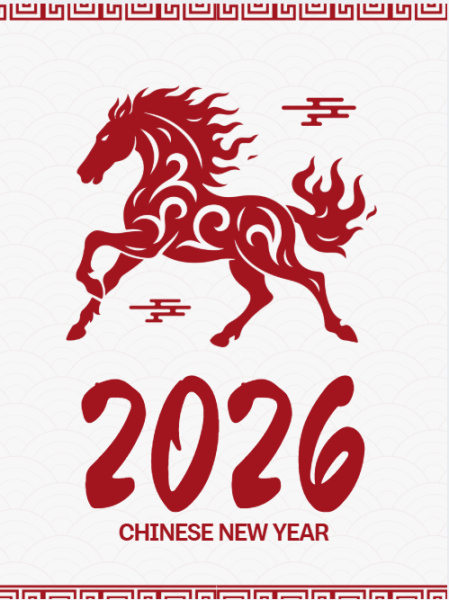
 Chinese New Year, otherwise known as the Spring Festival, or the Lunar New Year, is a traditional Chinese holiday celebrating the turn of the lunar calendar. This is a time where families gather together to eat and welcome the new year. Each new year is associated with a different animal from the Chinese zodiac.
In 2026, Lunar New Year falls on February 17th, kicking off the 16-day Spring Festival. It is the Year of the Horse, but this year is special. While the general Year of the Horse occurs every 12 years and represents energy and independence, the Fire Horse (occurring once every 60 years, e.g., 1966, 2026) is a specific, rare combination of the Horse’s innate traits with the fire element, creating extreme intensity, volatility, and accelerated transformation.
If you pay attention to astrology, this means 2026 is a good year to make changes and achieve goals. It’s a year for people to quit hesitating and move forward, whether that be overcoming a fear of speaking, asking someone out on a date, or starting a new job. It’s a time for rapid progress, new opportunities, and major shifts, but it also requires balance to avoid impulsiveness.
Each year has unique characteristics, but there are core elements that remain no matter the zodiac sign. Chinese New Year celebrations began over 3, 500 years ago originating during the Shang Dynasty in ancient agricultural societies that used the lunar calendar to mark the new year. The celebration is tied to traditions of honoring gods and ancestors while the legend of the monster Nian explains modern customs like decorating, lighting fireworks, and making loud noises to ward off evil. Gradually, the festival evolved from a sacred ritual to a social event with traditional customs.
The modern holiday includes welcoming good fortune by cleaning, decorating with red for luck, enjoying a big family dinner with symbolic foods, giving red envelopes with money, setting off fireworks, and watching dragon or lion dances. In some places, it’s forbidden to sweep or wash your hair on New Year’s Day, or you’ll wash away the luck.
This doesn’t sound so different from a regular American New Years celebration, so why isn’t it celebrated on Dec. 31st? The Chinese holiday is based on the lunar and zodiac calendars, so it changes each year. The lunar calendar tracks time based on the monthly cycles of the moon, meaning from new moon to new moon. A lunar month lasts about 29.5 days which results in about 354 in a year. This is shorter than a solar year. A pure lunar calendar would be the Islamic Hijri calendar that drifts through the seasons, while lunisolar calendars (Chinese and Hebrew) add an extra “leap” month to stay aligned with the solar year and seasons. This is used to determine holidays like Ramadan or Chinese New Year.
A zodiac calendar divides the year into 12 segments, each being linked to a constellation. In the Chinese system, they are connected to an animal. These calendars oftentimes use astrology to interpret personality and destiny based on birth time — a horoscope.
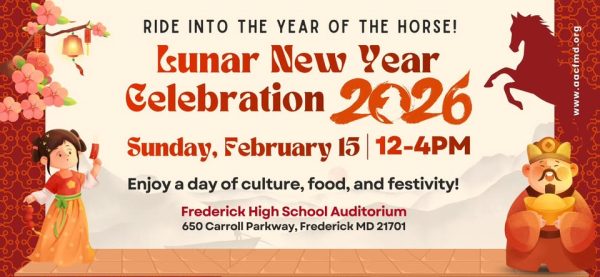
You don’t have to be Asian to celebrate Chinese New Year. You can find events in every major city in Maryland, including Baltimore, College Park, Rockville, etc. In Frederick, the Asian American Center of Frederick will be holding a Lunar New Year’s Celebration with cultural performances, displays of artwork, ethnic cuisine, and family friendly activities at Frederick High School. You can reserve tickets here.