

















Digging Up the Past
We all remember our teen years. Whether you were honed in on your studies, or looking for life outside the classroom, you’re sure to have lingering memories of your school’s crammed hallways. We often see our memories preserved in yearbooks and school newspapers. Mrs. Keiholtz, the publications teacher at Walkersville High, stumbled upon a piece of WHS history: old yearbooks and old, preserved newspaper prints from many years ago. The papers are very fragile, and Mrs. Keiholtz highlighted the importance of handling them with care. She uses special gloves, and the papers themselves are contained in plastic covers. When asked about preserving the papers, she detailed, “The Walkersville Historical Society is coming to take a look at them, and they’re going to be using the gloves and the acid free paper and all of the things that we’re using, and just continue to use them the way that we know is safe to keep preserving them.”
Gloves on hands, we perused the fragile pages that gave glimpses of what used to be.
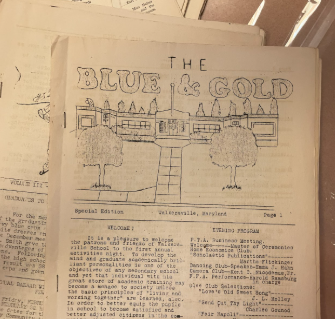
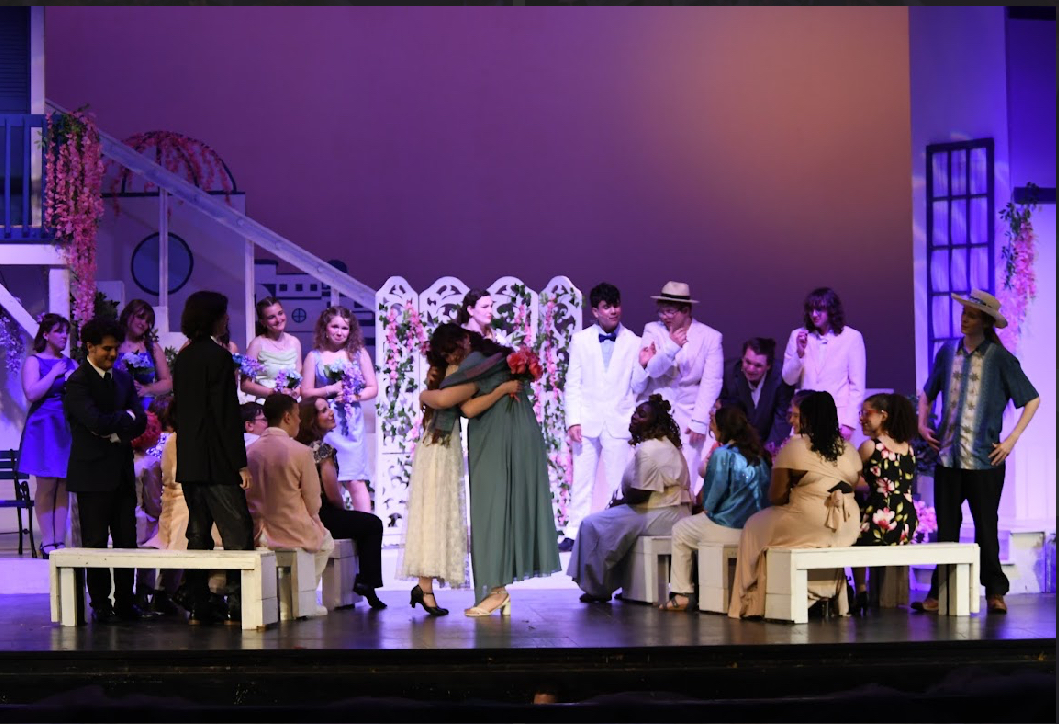
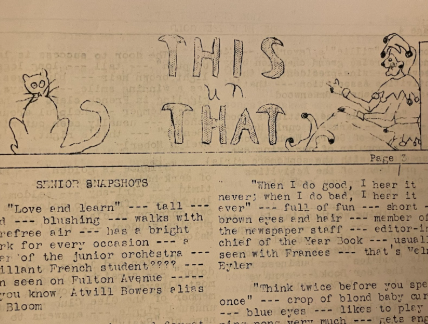
Walkersville’s student newspaper didn’t always go by WHS Lions Den. Back in 1940, it was the Blue and Gold! Walkersville used to be a very small school, so the published issues are much different than they are now. Names reappeared constantly, and town gossip and news were front page. Today, Lions Den runs more broad news: While still keeping it local, the team covers global news, arts and entertainment of all kinds, sports and games, and more. While we differ in these areas, we remain the same in community. Walkersville still has the FFA, Theater, and all sorts of clubs. It’s nice to look back to see where we came from.
The Blue and Gold kept the small town Walkersville well-informed. They frequently talked about their favorite hang-out spots, the town gossip, and general school news. Nowadays, we don’t print the paper, it’s all archived here digitally.
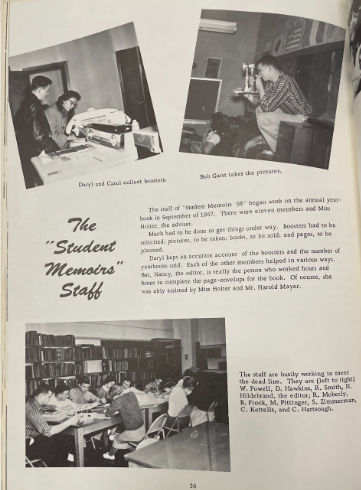
Another act of preservation of WHS’ history is yearbooks. In the school’s photo lab you can find a range of yearbooks on the shelves dating far back — like a time capsule. Mrs. Keiholtz shares her favorite memory of these yearbooks: “I had a class block with my yearbook crew. We had all of the tables lined up in a one big line, and we put all of the yearbooks out from the first one that we had, which is 1938 until I think it was like 2000 something, like basically what we could fit on the tables.” Students had a blast looking at how former students dressed and what they included in their yearbooks. It’s a great teaching and learning opportunity, especially for students looking to get into publications!
A Trip Down Memory Lane
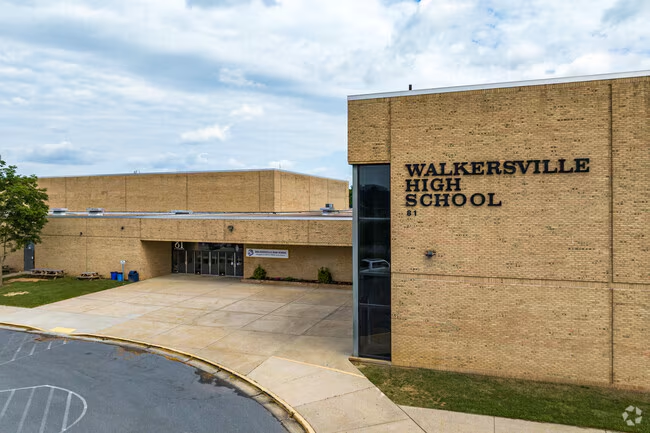
Let’s walk down the golden road of Walkersville for a minute. Walkersville officially became a town in 1892, founded by John Walker. Ever since then, Walkersville has grown as a community around the Glade area. Eighty-four years later, Walkersville High School was built, but the high school we know and love was built later on. Back in the early 1900s, the original Walkersville High School was built. Rather than being a school for 9th – 12th graders, the building was opened in 1922 to serve Walkersville students from grades one to eleven. The school continued as Walkersville High School until a larger building was constructed in 1960, which was the middle school. Finally, in the 1970s the current high school was built.
Walkersville’s Legacies
The Blue and Gold has done amazingly at preserving not only our town’s history, but also the histories of the people living here. When Walkersville was smaller than it is now, everybody knew everybody. Many students who attend now have family members who did too — some going as far back as the 1940s. Many names came up in the old papers, like the Zimmermans, whose farm has been here for a long time. Students with that same last name still attend and live here!
Looking Back, Moving Forward
Exploring a town’s history and the discoveries within it reminds us that every street, building, and artifact carries stories from the past. By uncovering old foundations, objects, and records, we don’t just learn about how people lived long ago–we also see how their choices shaped the place we know today. That ongoing process of discovery turns a simple town into a living museum, connecting the present to generations who walked the same ground long before us. While Walkersville has come a long way, we’re still connected by our roots.